
AFC Spring Newsletter 2026
/AFC Spring Newsletter
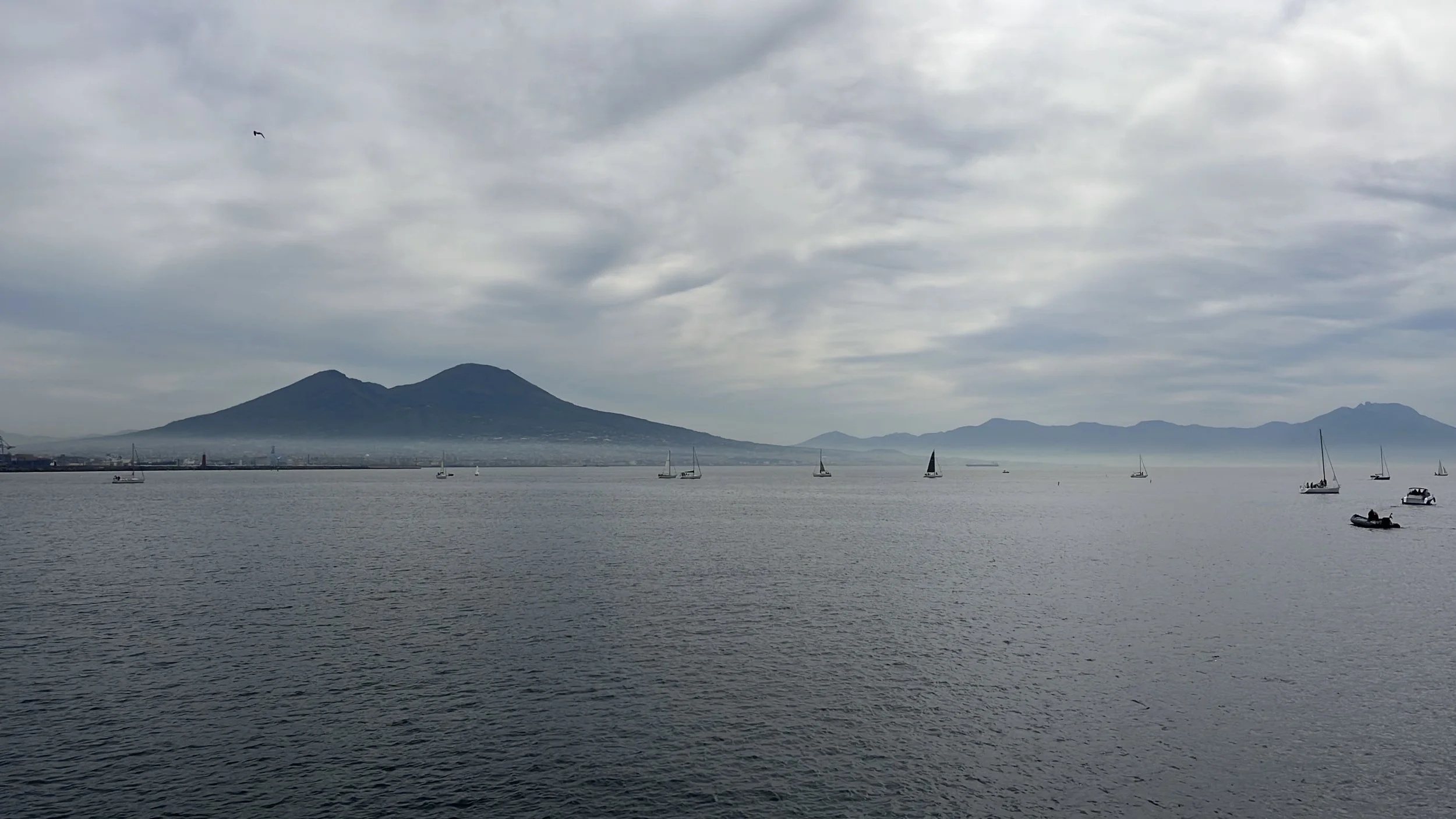
Vesuvius from the lungomare, April 2026. Photograph by AFC Postdoctoral Curatorial Fellow Gabriella Johnson.
AFC Postdoctoral Curatorial Fellow Gabriella Johnson on the Move
In addition to being a key member of the team shaping the reinstallation of Capodimonte’s newly renovated galleries, Gabriella has been on the move! With generous support from the American Friends of Capodimonte, Gabriella traveled to
Maastricht to attend The European Fine Arts Fair (TEFAF), where she studied Old Master paintings, drawings, and sculptures available on the open market alongside other curators, scholars, and collectors. In Gallerie Canesso’s booth, she studied Giuseppe Bonito’s The Painter’s Studio, a pendant (or two paintings conceived as an iconographically or conceptually linked pair) to Bonito’s The Huntsmen in the Capodimonte collection.
Awarded the Renaissance Society of America-Samuel H. Kress Research Fellowship in Renaissance Art History, Gabriella also spent an exciting week in Sicily conducting onsite research for her forthcoming book on the Messinese painter Agostino Scilla. Both trips have enriched her ongoing projects at Capodimonte.
Click here to learn more about Gabriella on the AFC website and follow her updates from Capodimonte on Instagram: @american_friends_capodimonte.
Contemporary Voices at Capodimonte
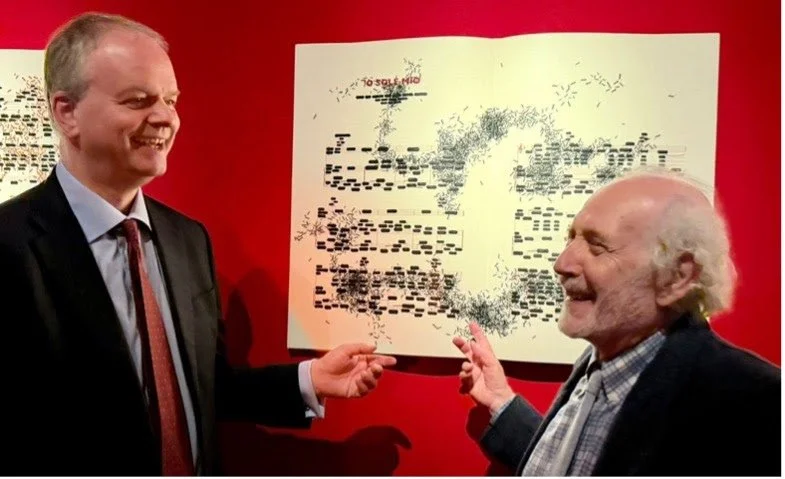
Director Eike Schmidt discussing artist Emilio Isgrò’s reinterpretation of the famous Neapolitan song ‘O Sole Mio during the exhibition opening of Emilio Isgrò. Canto Napoli, Galleries 82, 84, and 85.
April saw the opening of two contemporary art exhibitions at Capodimonte: Emilio Isgrò. Canto Napoli (Emilio Isgrò. I Sing Naples) and I Segni dei Tempi. Carlo Maria Mariani a Capodimonte (Signs of the Times. Carlo Maria Mariani at Capodimonte).
Emilio Isgrò. Canto Napoli features the sheet music of popular Neapolitan songs, from the nineteenth century to Pino Daniele, reimagined through Isgrò’s technique of “cancellatura,” or “erasure.” His interventions, “erasing” notes, clefs, and lyrics in dense black strokes or obscuring them with swarms of insects, hover along the musical staff not as voids, but opportunities find new meanings in the familiar verses of famous songs. Since the 1960s, Isgrò has employed the poetic and pictorial language of “cancellatura” as a critical tool to reflect on language, memory, and the creation of knowledge.
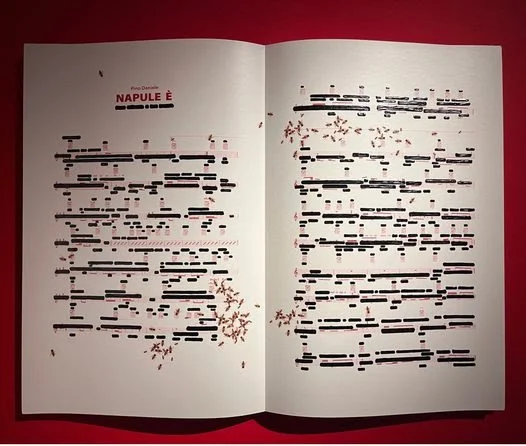
In one stunning example (illustrated below), Isgrò “erases” nearly every word in Pino Daniele’s heartfelt hit, “Napule è,” except two poignant lines that describe the dynamic city as “tutto nu suonno” (all a dream) and “mille paure” (a thousand fears). The exhibition spans three galleries (82, 84, and 85) on the second floor.
I Segni dei Tempi. Carlo Maria Mariani a Capodimonte celebrates the donation of the exhibition’s titular work, I Segni dei Tempi (2019), to Capodimonte by the Carlo Maria Mariani Foundation in New York.
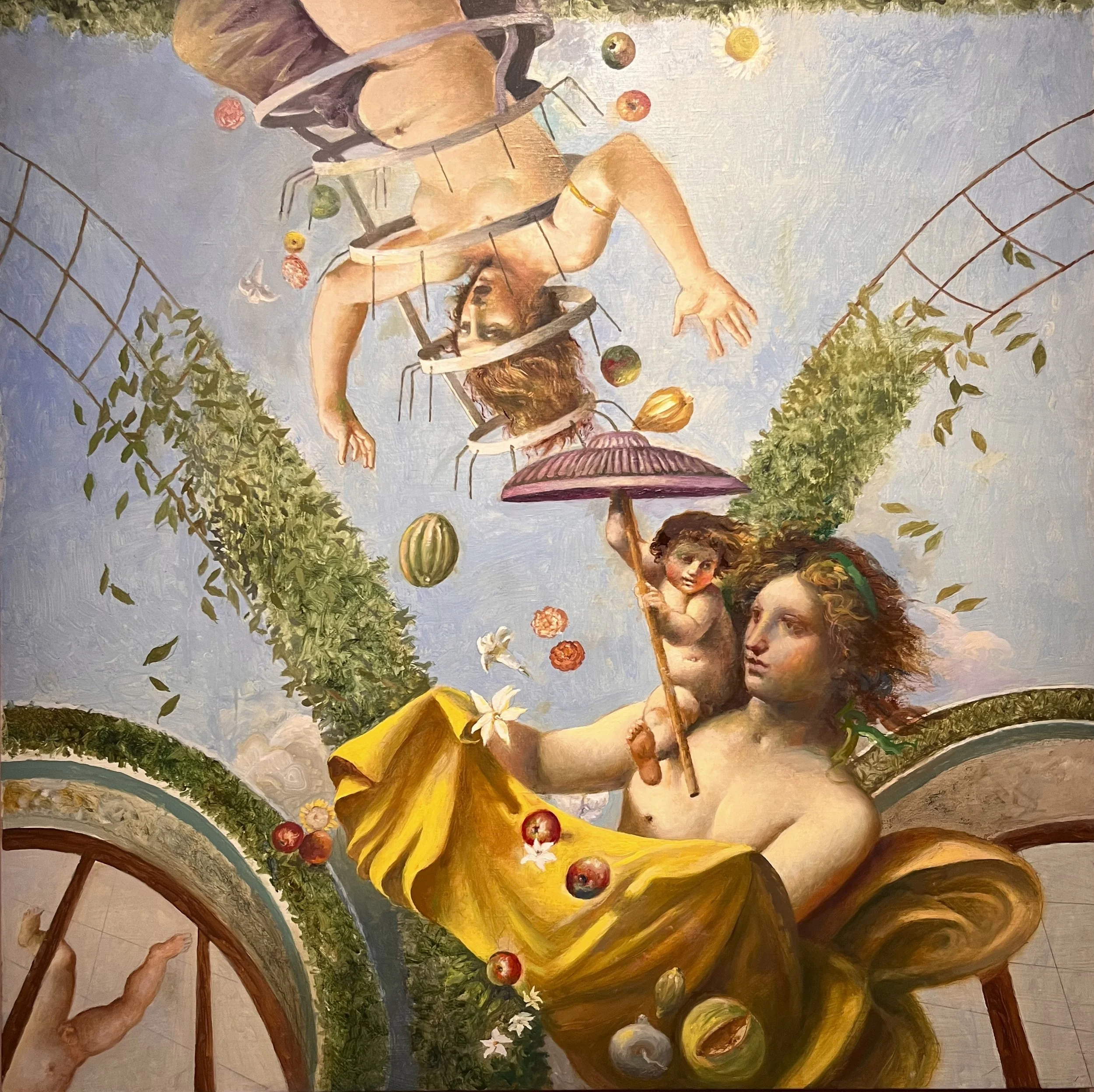
Carlo Maria Mariani, I Segni dei Tempi, 2019. Donated by the Carlo Maria Mariani Foundation in New York.
I Segni dei Tempi captures Mariani’s relationship with the past. Set against Renaissance painter Raphael’s frescoed sky in Rome’s Villa Farnesina, a figure dressed in ancient garb falls through conceptual artist Marcel Duchamp’s Bottle Rack, an everyday object Duchamp redefined as “art” through his notion of the “readymade.” Mariani’s recognizable artistic citations collapse Renaissance and twentieth-century temporalities in a single composition that explores how legacies of the past continue to shape the present.
The exhibition, occupying Gallery 6 on the first floor, continues the emphatic juxtaposition proposed by I Segni dei Tempi by putting Mariani’s works from private collections in dialogue with a bronze statuette of Hercules and porcelain from Capodimonte’s permanent collection.
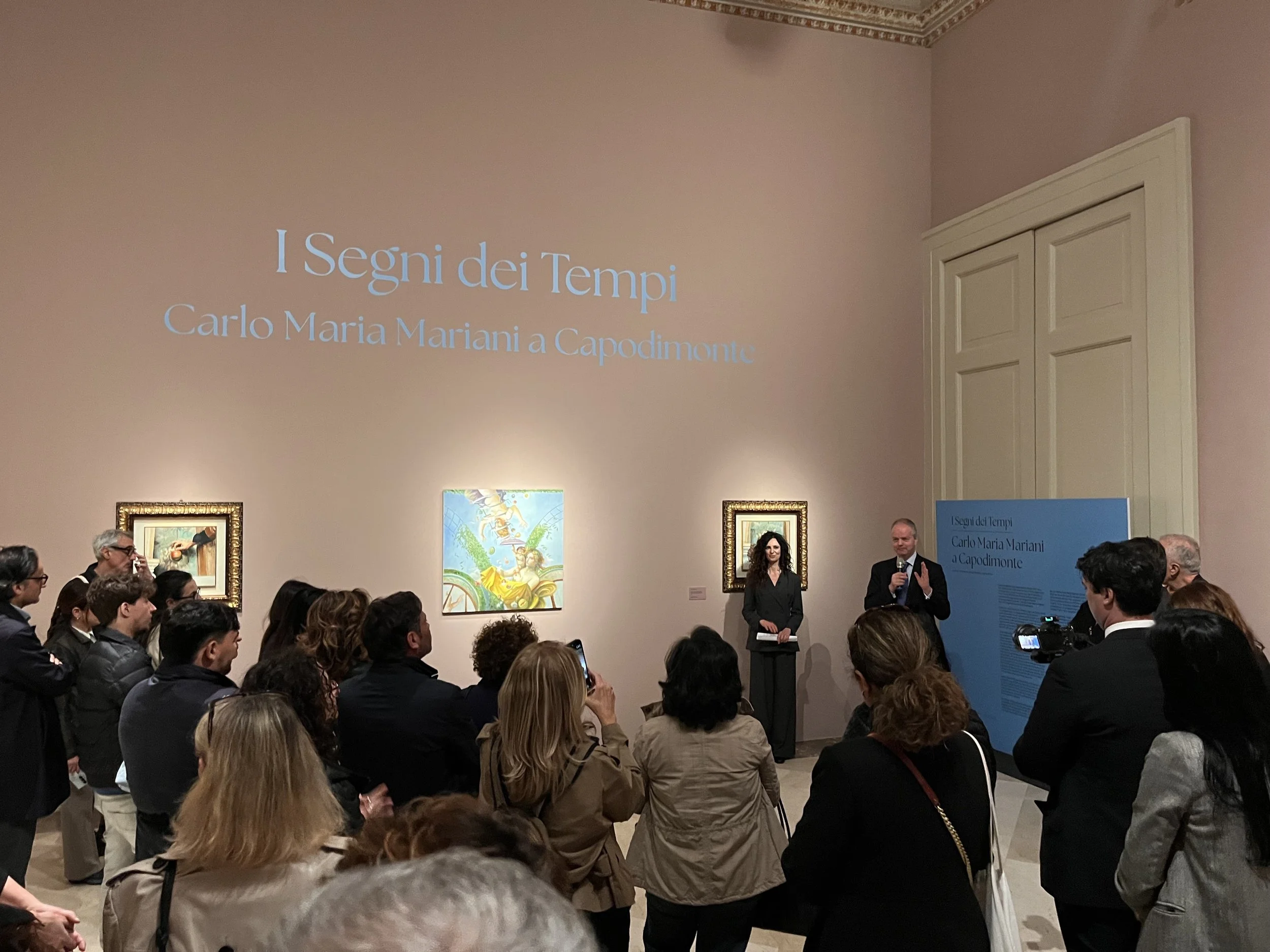
Installation view during the opening of I Segni dei Tempi. Carlo Maria Mariani, Gallery 6, with Director Eike Schmidt and actress Paola De Crescenzo.
Collection Highlight: Giuseppe Recco’s Still Life with Game and Flowers
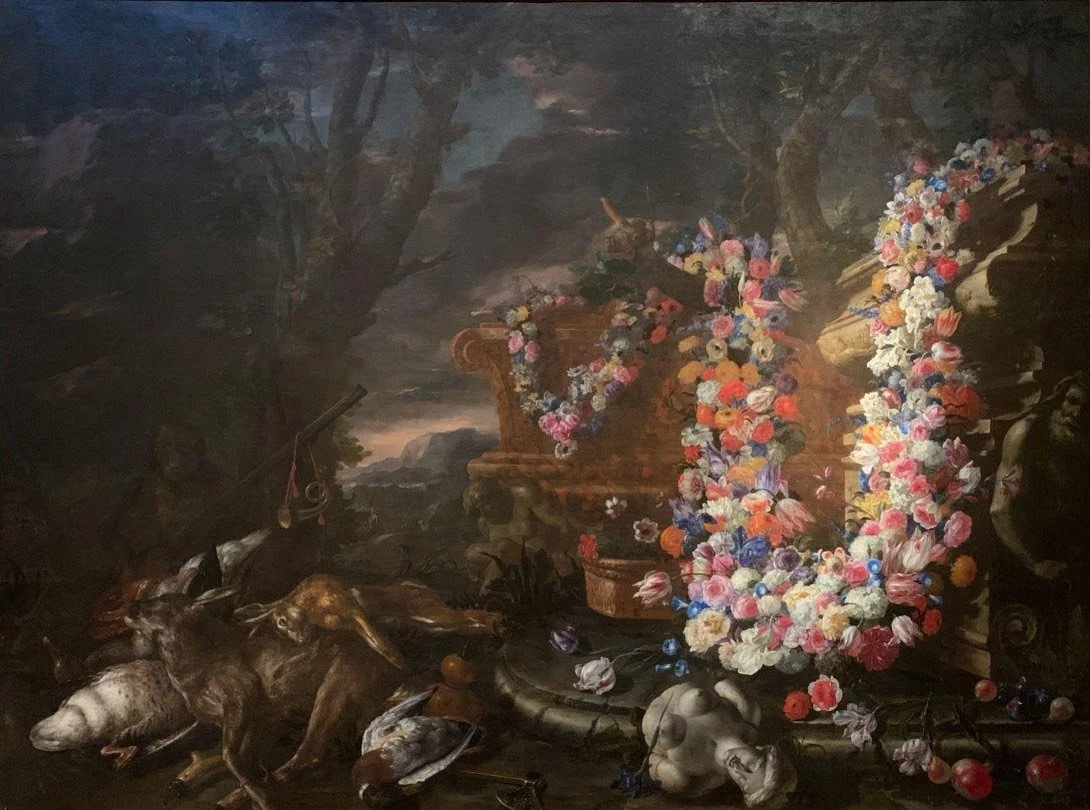
Giuseppe Recco, Still Life with Flowers and Game, 1671. Oil on canvas. Naples, Museo di Capodimonte. D’Avalos Bequest.
Neapolitan artist Giuseppe Recco’s Still Life with Flowers and Game is one of four still life paintings commissioned by the D’Avalos family in 1671. The cycle, exhibited together at Capodimonte, celebrates the abundance and variety of Campania’s produce, flowers, game, and marine life.
An impressive garland of flowers from all seasons decorates two ancient tombs positioned near a pile of hunted game. Below the flowers (freshly cut, but soon to fade!), a fragmented sculptural bust eroded by the passage of time heightens this elaborate memento mori, or reminder of the inevitability of death. The painting’s larger-than-life dimensions highlight the incredible variety of botanical Naples and its surrounding countryside.
Still life painting from the D’Avalos Collection at Capodimonte is the subject of a chapter in Gabriella’s forthcoming book about how the sea and its creatures shaped art, life, and culture in seventeenth-century Naples.
AFC Fellow Gabriella Johnson Teaches High Schoolers Visual Literacy
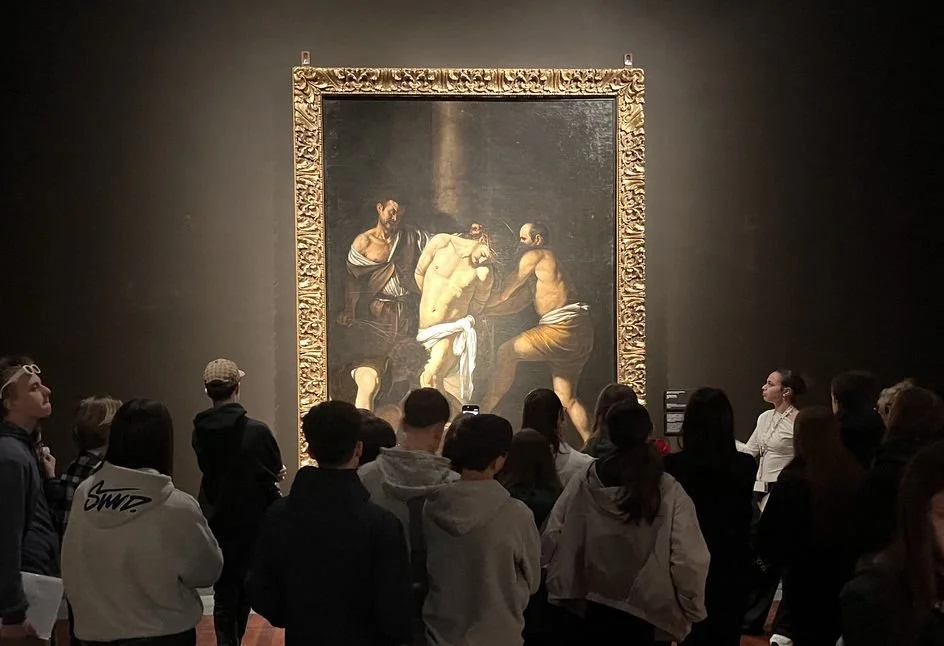
A ballerina from a Neapolitan fine arts high school (liceo artistico) discusses Caravaggio’s Flagellation with visitors.
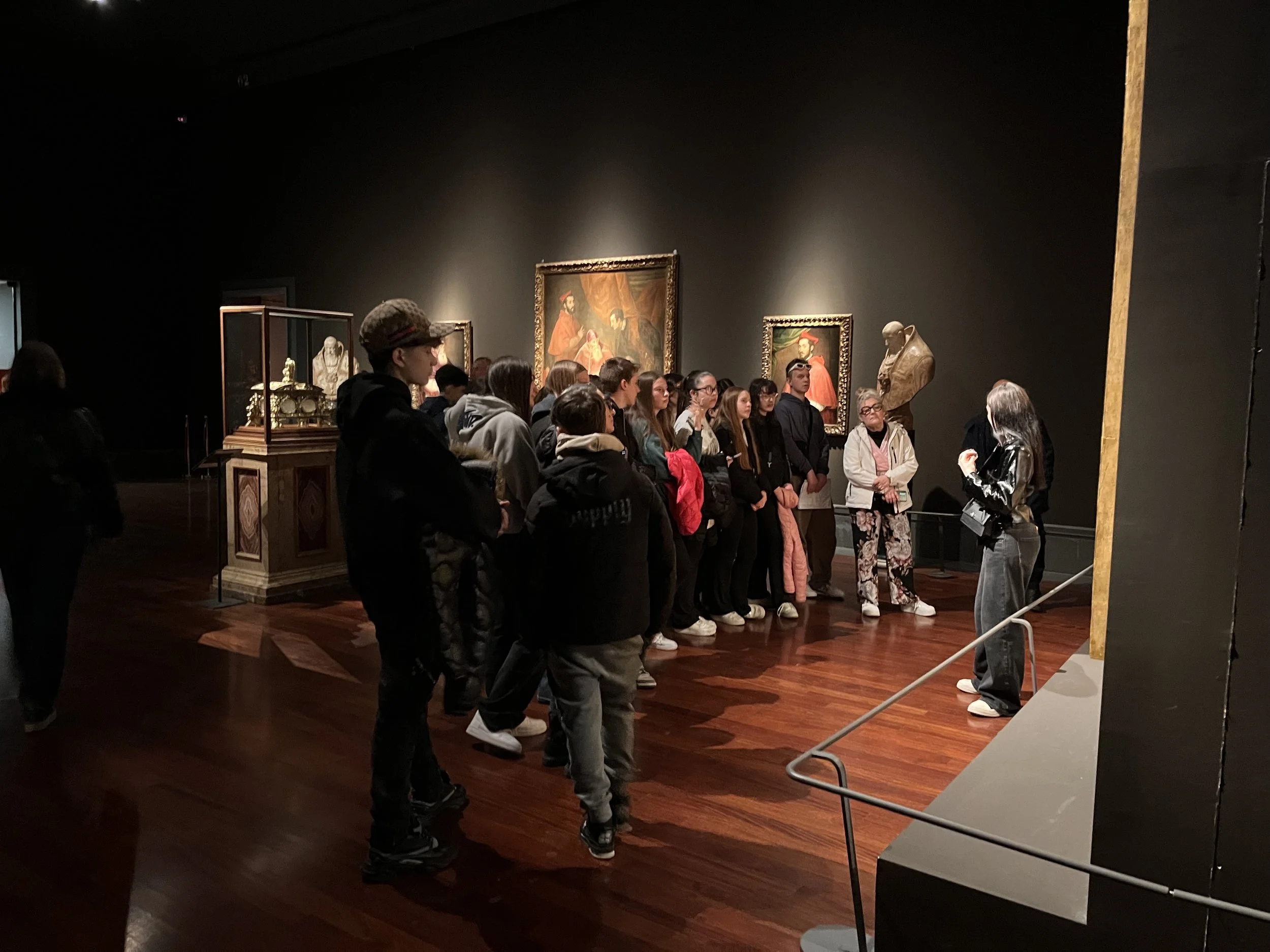
Alongside Curator of Modern and Contemporary Art Maria Laura Chiacchio, Gabriella has been teaching Neapolitan fine arts students visual literacy from the sensational works in Capodimonte’s collection. This public outreach program helps students understand how to “see” with a critical eye — an important skill to carry into our image-rich contemporary world. Each week, students learned how artistic forms generate meaning in discussion-based tours of the collection. At the end of the program, students became ambassadors in the galleries ready to spark engaging conversations with visitors and introduce the public to the splendors of Capodimonte.
Research in the Galleries: Colantonio’s St Jerome in his Study
Scholars, curators, and conservation scientists — at Capodimonte and based in Naples — gathered in Galleries 67 and 68 to share their focused research on the workshop practice of Colantonio (Niccolò Antonio), an important artist active in Naples between 1440-1460. A MacroXRF scanner, developed by the Istituto di Scienze del Patrimonio Culturale of the Consiglio Nazionale delle Ricerche, produced a high-definition image of St Jerome in his Study using x-ray fluorescence to reconstruct the pigments of Colantonio’s palette, his development of the composition, and any modifications made during the painting process. Discussions from this collaborative workshop will deepen scholarly understanding of the use of oil paint in southern Italy. Colantonio developed his skill in oil paint through exposure to Flemish painters at the court of King René of Anjou.
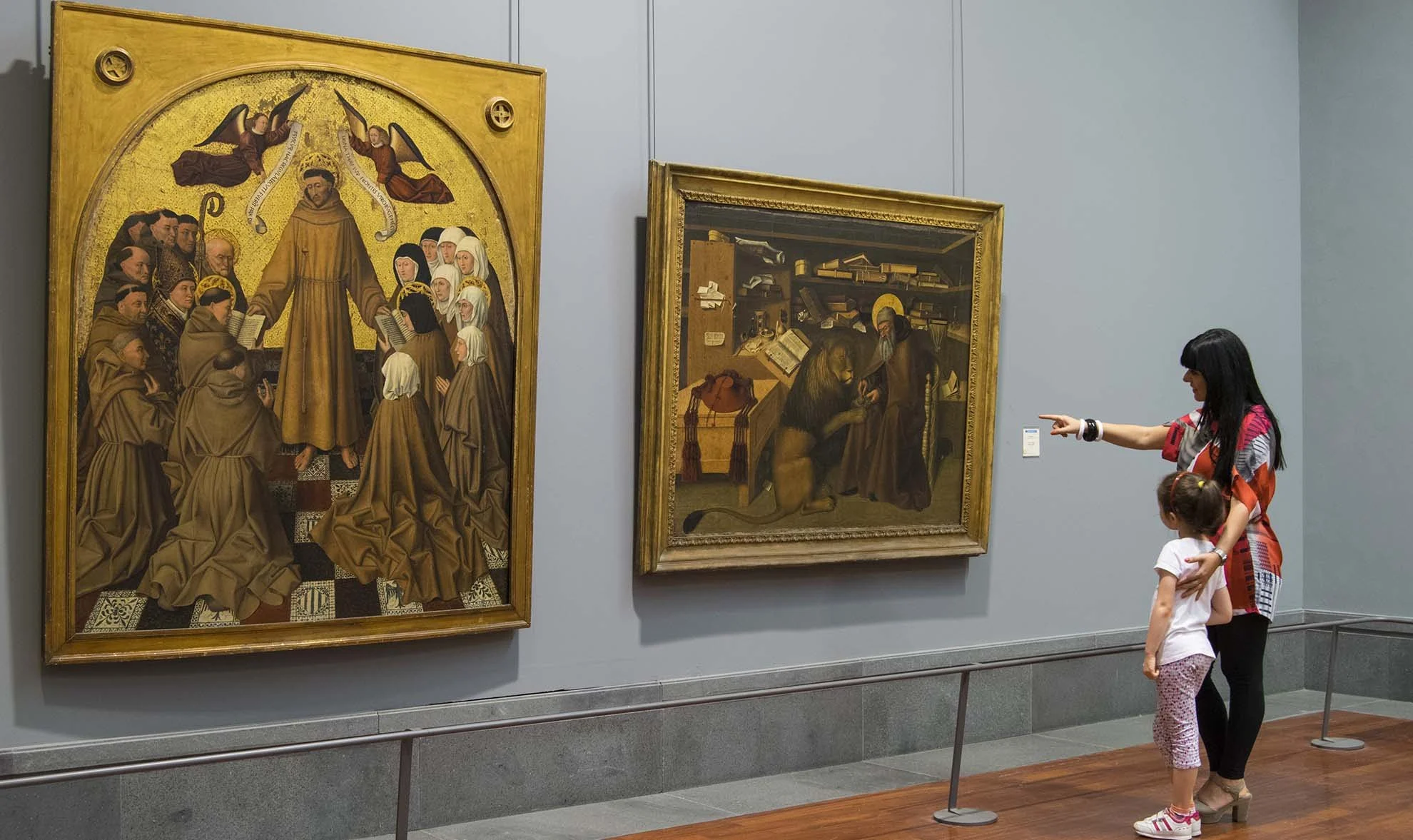
The Delivery of Franciscan Rule and St Jerome in his Study by Colantonio, two masterpieces by the artist originally made for the church of San Lorenzo in Naples and now in the Capodimonte collection.
Director Eike Schmidt highlights the importance of this initiative: “[This workshop] brings research into the heart of the museum, in front of the work of art, to delve into the heart of artistic technique. It is a story that begins with Colantonio himself to underscore the importance of fifteenth-century southern painting and, in particular, of this leading figure. We will continue to create public outreach opportunities to introduce visitors, in an accessible way, to the multi-layered images generated by conservation research.”
Updates from Former AFC Fellow Caroline Paganussi (2021-2023)
Caroline Paganussi (AFC Fellow 2021-2023) has been appointed Lecturer in Art History at the University of Sydney. In this role, Caroline teaches courses at the undergraduate and postgraduate level in Art History, Museum & Heritage Studies, and Italian Studies. She also supervises postgraduate dissertations and serves as the Academic Supervisor for placements, assessing the work postgraduate students produce related to internships undertaken at museums, galleries, and heritage sites throughout Australia and around the world. Her most recent article, “From Manila to Bologna and Beyond: The Maritime Trajectory of an Eighteenth-Century Philippine Bamboo Container,” was published in the January 2026 issue of the journal Eighteenth-Century Life and relates to projects she worked on during her time as the AFC fellow. She is very pleased to have found a role that is both academic and embedded in the museum world!
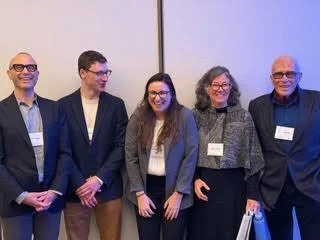
David Drogin, Benjamin Weil, Caroline Paganussi, Nancy Turner, and Peter Weller are all smiles after presenting on the Italian Art Society-sponsored panel “Bologna c. 1400” at the Annual Meeting of the Renaissance Society of America in February in San Francisco.
AFC Member Tours of Capodimonte
Gabriella is delighted to offer tours of Capodimonte and its surrounding park to AFC Members. Reach her at fellow@americanfriendsofcapodimonte.info.
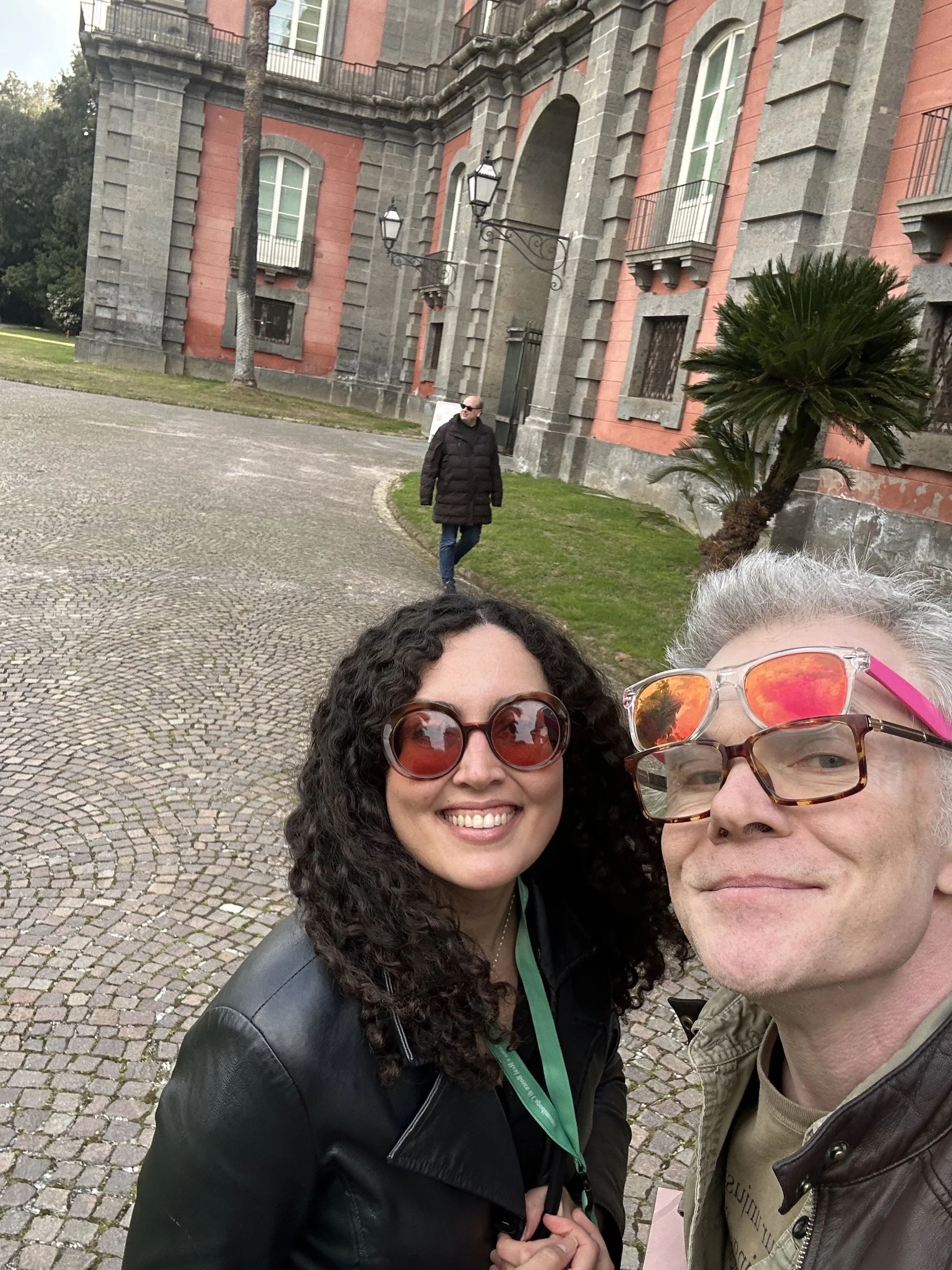
AFC Fellow Gabriella Johnson with Rhode Island School of Design professor and printmaker Dan Wood after his visit to Capodimonte.